← Projects3/6
Affective Acoustics
Graduation Project
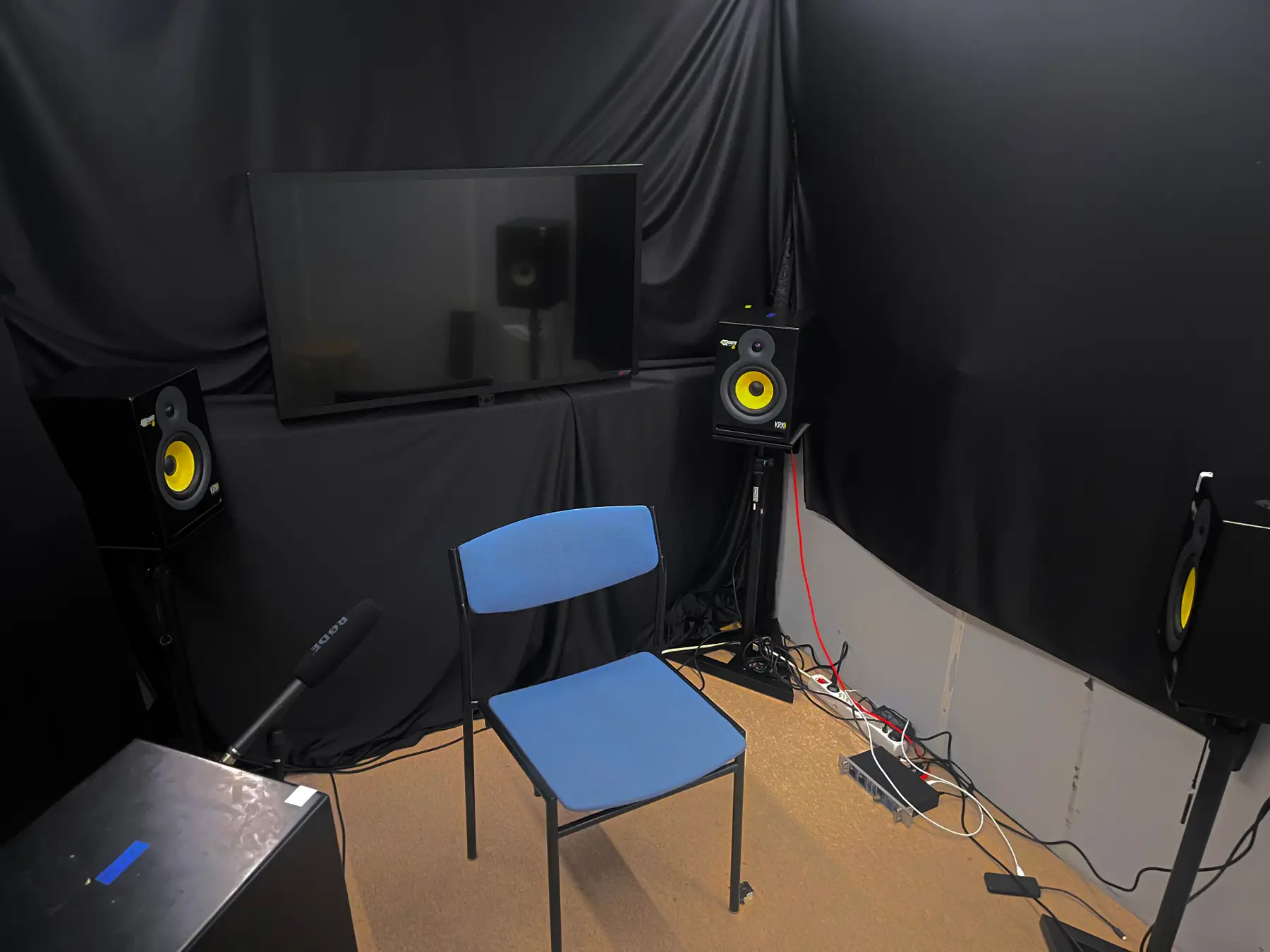
We can hear space, just as light allows us to see it. Sound reveals space by interacting with its physical components, enabling us to sonically experience its fundamental properties—size, shape, and boundaries. As sound waves travel, they reflect, diffuse, and are absorbed by surrounding surfaces. These interactions provide cues about a space’s dimensions and boundaries, allowing us to construct a mental representation of our surroundings, even in the absence of vision. An aspect of spatial perception in this paper is the perception of size and its influence on emotional experience. A space that feels too small may induce a sense of claustrophobia and confinement, while an overly large space—such as a vast cathedral or an empty basement—can evoke detachment or disorientation. These emotional responses emerge from how individuals interpret spatial scale rather than from physical dimensions alone. Despite the recognized role of spatial scale in shaping emotional experience, much of the existing research has focused on visual perception, leaving the auditory perception of spatial scale—and its emotional consequences—relatively underexplored.
Addressing this gap, the present study investigates how auditory spatial cues related to room size and its surface material influence participants’ spatial perceptions and emotional reactions. By isolating auditory inputs and removing visual context, the study examines whether the subjective feeling of spaciousness corresponds to the objective size of a space and how these auditory variations affect emotional states such as comfort, safety, and anxiety. The study systematically varies these auditory conditions to measure their effects on participants’ spatial and emotional evaluations.